Tiered Cake Stand for Afternoon Tea: Buy One or Use Plates?
- Do You Need a Tiered Cake Stand for Afternoon Tea?
- What Does a Tiered Stand Actually Do?
- Is a Tiered Stand Traditional?
- What Goes on Each Tier of an Afternoon Tea Stand, and Why?
- What Should You Look For If You Buy One?
- How Do You Serve Afternoon Tea Without a Stand?
- How Long Can the Food Sit Out?
- So, Should You Buy a Stand?
- Sources
Do You Need a Tiered Cake Stand for Afternoon Tea?
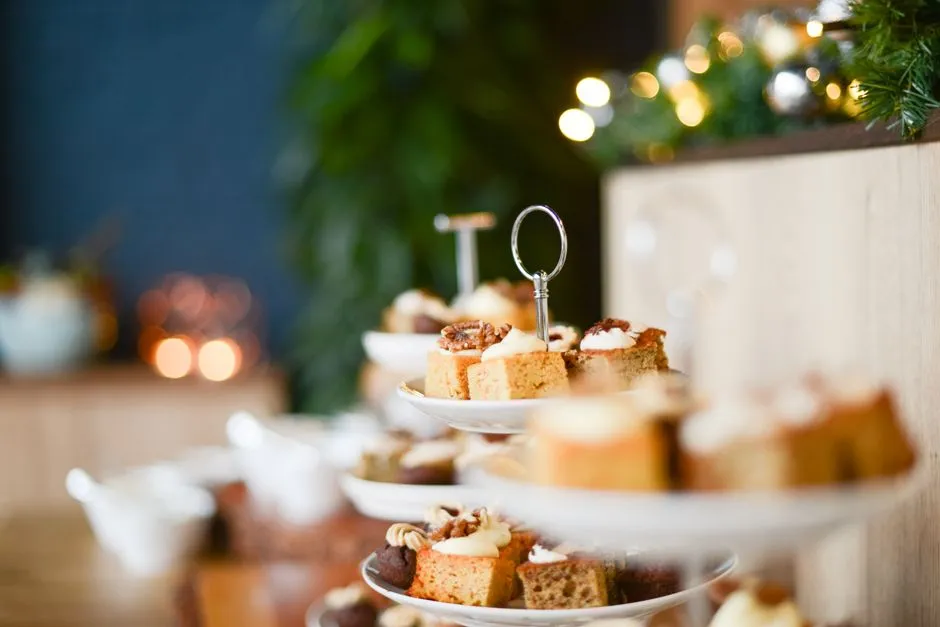
No. A tiered cake stand for afternoon tea is a convenience and a bit of theatre, not a requirement. It stacks three plates on a central rod, so the whole spread sits on the footprint of one plate, and it sets the food out in eating order: sandwiches on the bottom, scones in the middle, small sweets on top. If you do not own one, the plates, board and bread basket already in your cupboard lay a perfectly good table.
What Does a Tiered Stand Actually Do?
It does two jobs: it saves table space, and it lets one person pass several things at once.
Space. Take a porcelain catering stand listed at 355 mm high with plates of 152 mm, 229 mm and 270 mm (Diamond DCS). Laid flat side by side, those three plates would cover roughly twice the table area of the 270 mm plate alone, and the 270 mm plate is all the stand occupies. On a coffee table that already holds a teapot, cups, a milk jug and jam dishes, that is the difference between room for everything and saucers balanced on knees.
Passing. Mrs. Massey Lyon, writing in 1927 and quoted in TeaTime magazine's history of the tiered stand, said that for a hostess serving tea on her own, "one of the tiny tiered stands which take their place upon the table prove most convenient", because it let her pass several things to her guests at once. That still holds. One stand turned or moved around the table does the work of three plates handed round.
Is a Tiered Stand Traditional?
Less than it looks. The same TeaTime history, written by Jane Pettigrew, says "the earliest plated-silver cake stands were manufactured in the 1880s and ’90s", and that before then cakes and pastries usually came to the table in silver baskets or on glass or porcelain platters raised on a modest pedestal. By 1922, Emily Post was describing a stand of three small shelves, "each just big enough for one good-sized plate". Serving afternoon tea from plates and baskets is the older habit, not a compromise.
What Goes on Each Tier of an Afternoon Tea Stand, and Why?
The familiar arrangement, which some tearooms and hotel lounges use according to TeaTime, puts the sandwiches on the lowest tier, the scones in the middle and the small pastries on top. The same article is clear that "there are no rules", but the usual order earns its place at the table for practical reasons, not just looks:
- Bottom tier: sandwiches. Savouries are eaten first, so the first course sits lowest and nearest the hand. Sandwiches are also the bulkiest course, at four to six fingers per guest, and the bottom plate is the largest. Putting the most weight lowest keeps a tall, narrow stand steady.
- Middle tier: scones. Scones come second and need jam and cream beside them. If you want them warm, TeaTime suggests setting dishes of jam, butter and clotted cream on the middle tier and bringing the scones out only when guests are ready for them. Our guide to scones that rise tall covers the bake so the timing works.
- Top tier: sweets. The smallest plate takes the smallest, prettiest things, such as miniature tarts or slim fingers of Victoria sponge. They are eaten last and sit on display for the whole meal.
Some hosts swap the lower two. TeaTime notes that hosts who serve warm scones as the opening course put them on the bottom tier and the savouries in the middle. Whatever the layout, guests usually work savoury, then scones, then sweet. The full menu and the etiquette that matters are in what afternoon tea is and how to host it.
What Should You Look For If You Buy One?
You do not need the expensive one. You need one that stands firm, washes the way you wash, and fits in your cupboard.
Stability. Look for a solid central rod, fittings that tighten securely, and a broad bottom plate. A loaded stand is tall, narrow and made of china. Assemble it where it will be used, follow the maker's instructions for the fittings, set it well back from the table edge and out of reach of small children, and do not lift it by the top handle when it is full.
Washing. Check the listing before you buy, because stands differ. A fine bone china stand with 22-carat gold decoration sold by the Royal Collection Shop is listed as "Not suitable for use in a dishwasher or microwave". The porcelain catering stand above is listed with plates that are "dishwasher safe for an easy clean". If you want to load the dishwasher after a party, buy plain porcelain listed as dishwasher-safe. If a listing does not say, assume hand-wash.
Size. Plate sizes matter more than height. The bone china stand is 39 cm tall with tiers of 17 cm, 22 cm and 28 cm; the catering stand is 355 mm tall with plates of 152 mm, 229 mm and 270 mm. Measure the shelf it will live on and the table it will stand on, and picture how much food a 15 to 17 cm top plate really holds.
Storage. A stand whose rod unscrews comes apart into flat plates that stack with the rest of your china. A one-piece stand needs a shelf of its own. If the listing does not say whether it dismantles, ask before you buy.
How Do You Serve Afternoon Tea Without a Stand?
Use what you own and lay it out in eating order, nearest to farthest or left to right, so guests can read the meal at a glance.
- Sandwiches go on your largest platter or a long wooden board, in neat rows by filling.
- Scones go in a bread basket or bowl lined with a clean napkin, folded over to hold the warmth, with jam and cream in small bowls, each with its own spoon.
- Cake goes on a footed cake plate if you have one. A raised plate gives a single sponge the same sense of occasion as a stand. Small sweets can share a side plate.
- Tea things can move to a side table or tray if the main table is tight, which frees the centre for food.
Plates have one real advantage: everything sits at the same height, so nobody reaches over a tower to get the milk.
How Long Can the Food Sit Out?
Whether it is on a stand or on plates, the food sits at room temperature for the length of the tea. The Food Standards Agency's guidance is to "Keep chilled food out of the fridge for the shortest time possible during preparation (a maximum of four hours)" (Food Standards Agency). Time on the table adds to time spent preparing, so keep cream and sandwich fillings in the fridge until shortly before guests sit down, assemble sandwiches as late as you can, and clear cream and sandwiches away once tea is over.
So, Should You Buy a Stand?
Buy one if you host often, your table is small, or you love the moment it lands on the table. Skip it if you host once a year; plates, a board and a basket do the job, and the money goes further on good tea. Either way, the thing guests remember is warm scones and a well-brewed pot, so time the bake and brew the tea properly.
Sources
- TeaTime magazine: The Three-Tier Cake Stand, page 1
- TeaTime magazine: The Three-Tier Cake Stand, page 2
- TeaTime magazine: The Three-Tier Cake Stand, page 3
- TeaTime magazine: The Three-Tier Cake Stand, page 4
- Diamond DCS: Olympia 3 Tier Afternoon Tea Cake Stand
- Royal Collection Shop: Victoria and Albert 3 Tier Cake Stand
- Food Standards Agency: How to chill, freeze and defrost food safely