Milk in Tea First or After? What It Changes in the Cup
- Should milk go in tea first or after?
- What actually changes when you pour milk first?
- Can you actually taste the difference?
- Why does the order matter more with a tea bag in a mug?
- What about serving from a teapot?
- Where did the milk-first habit come from?
- Which teas are usually taken without milk?
- How hot should tea be when you drink it?
- So which should you do?
- Sources
Should milk go in tea first or after?
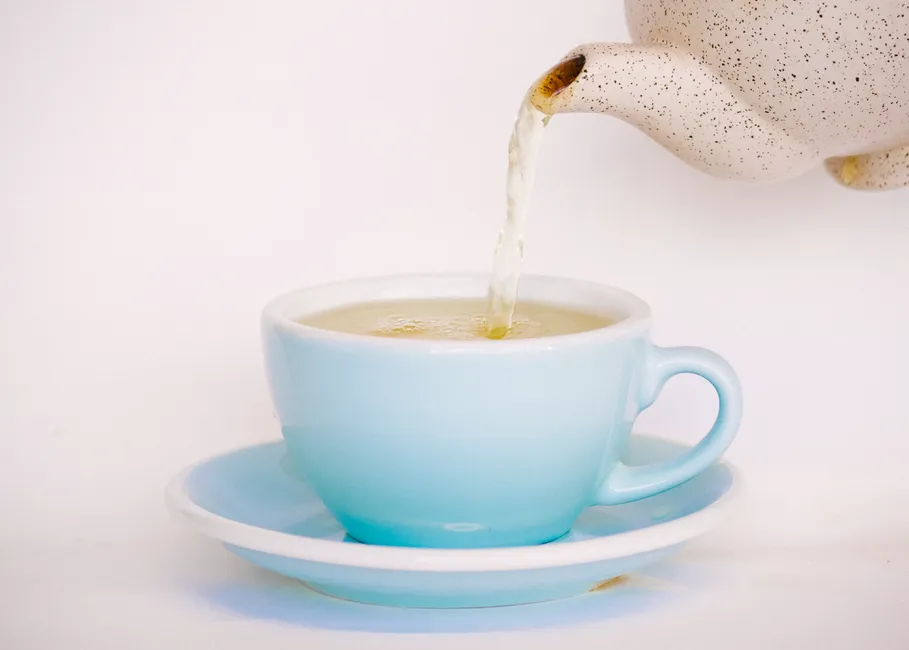
Either order makes a good cup, and the taste difference is small at most. What decides it is how the tea is made. If you brew a tea bag in a mug, add the milk after: cold milk poured in first lowers the water temperature, and black tea needs water close to boiling to brew properly. If you pour finished tea from a pot, milk first or last is a free choice. Milk first mixes as you pour; milk after lets you judge the colour.
What actually changes when you pour milk first?
The temperature the milk meets. Pour tea onto milk and the milk warms gradually as the hot tea lands on it. Pour milk into tea and the first splash of cold milk hits liquid at full heat.
That is the whole scientific case for milk first. A guide the Royal Society of Chemistry published in 2003, based on advice from Dr Andrew Stapley of Loughborough University, told readers to pour milk into the cup first, because milk proteins are liable to denature (break down and change structure) if the milk meets temperatures above 75°C. Pouring the tea onto the milk, the guide argued, keeps the mixture below that point. A 2015 NPR piece reports Stapley's argument that milk added first heats evenly, while milk poured into the tea has its proteins unfold unevenly, which he links to the skin that forms on top of a cup.
Can you actually taste the difference?
Possibly not. In the same NPR piece, Mark Miodownik, a materials engineer at University College London, said that when he tried to replicate the effect, no informal taste tester was ever able to perceive a difference.
You can settle it at your own table. Brew one pot, set out two identical cups with the same amount of milk, pour one each way, and have someone else hand them to you without saying which is which. If you cannot pick them, the order is habit, not flavour.
What you will notice, every time, is how much milk goes in and how strong the tea is underneath it. Milk softens tea: McGill University's Office for Science and Society notes that milk can help counteract the astringent or bitter side of tea's tannins. Too much milk on a weak brew gives a flat, milky cup whichever order you poured.
Why does the order matter more with a tea bag in a mug?
Because in a mug, the brewing happens in the cup you are drinking from. Black tea wants water at roughly 90–100°C (the full table is in our guide to brewing tea properly). Put the milk in first and drop the bag on top, and the water lands on cold milk, falls well below that range straight away, and the bag brews slowly and weakly.
The reliable mug method is simple. Pour the just-boiled water over the bag, leave it for three to five minutes, take the bag out, then add milk until the colour looks right to you. Adding milk last also lets you see the strength before you commit.
What about serving from a teapot?
With a pot, the tea has already brewed before it reaches the cup, so milk first no longer gets in the way. For a host, the practical answer is to put a jug of milk on the table and let each guest choose. Pouring tea onto milk mixes it without a spoon; adding milk afterwards lets someone who likes a pale cup or a dark one judge it by eye. If you are setting a full table, our guide to what afternoon tea is and how to host it covers the rest of the service.
The international standard for brewing tea, ISO 3103, is often quoted on this. Its procedure adds milk to the tasting bowl before the tea, unless that is contrary to the organisation's normal practice, and notes that where milk is added after, best results come when the liquid is between 65 and 80°C. That standard exists so professional tasters can compare teas on equal terms, not to define the best everyday cup, so treat it as one more vote rather than a ruling.
Where did the milk-first habit come from?
The usual explanation is that early teacups were fragile and liable to crack when hot tea was poured straight into them, so a little milk went in first to soften the shock. It is a widely repeated story, but McGill's Office for Science and Society points out that the heat-shock theory is hard to validate. Either way, that history does not change what is in your cup today.
Which teas are usually taken without milk?
Milk suits strong black teas. Assam is the classic example: The Happy Foodie's guide to the perfect cup of tea says milk tempers its strong flavour, and that very light teas such as Darjeeling can easily be overwhelmed by it. The same guide says green, white and yellow teas, along with aromatic and floral teas, should be drunk without milk.
In practice, that gives a short rule for the tea tray:
- Usually with milk: robust black teas and breakfast-style blends, and rooibos, which takes milk well.
- Usually without: green, white and yellow teas, fine oolongs, floral and scented teas, and most herbal and fruit infusions.
- Your call: lighter black teas such as Darjeeling, where a small splash is the most they can carry.
One firm rule: lemon and milk do not go in the same cup, because the acid curdles the milk. Offer one or the other.
How hot should tea be when you drink it?
The Royal Society of Chemistry guide put the ideal drinking temperature at 60–65°C. Tea poured from a freshly boiled pot is hotter than that, and adding milk only takes some of the heat off. Let a fresh cup stand before drinking, and keep hot pots and cups well back from the table edge when children are around.
So which should you do?
- Tea bag in a mug: brew in water only, remove the bag, then add milk.
- Tea from a pot: milk first or after, whichever you prefer. Set out the jug and let guests choose.
- Green, white or floral tea: skip the milk altogether.
With the tea sorted, the only question left is what goes beside it. A warm batch of scones that rise tall is a good place to start.
Sources
- Royal Society of Chemistry: How to make a Perfect Cup of Tea (Dr Andrew Stapley, Loughborough University), reproduced by UAIQ
- Improbable Research: Perfect cuppa, in reprise (dates the RSC guide to 2003)
- NPR, via KPBS: Tea Tuesdays: The Chemis-Tea Of Pouring The Perfect English-Style Cuppa
- McGill University Office for Science and Society: tea and milk
- ISO 3103 (Wikipedia summary of the standard)
- The Happy Foodie: The perfect cup of tea